Articles by ecothrust at Technorati Headline Animator

Showing posts with label Technology. Show all posts

Thursday, July 14, 2022

Xiaomi, Vivo and Huawei caught in money laundering and duty evasion reveal how China captured India’s smartphone market

After Xiaomi was caught by the Enforcement Directorate in the massive royalty fraud and money laundering case last month Vivo has been booked for duty evasion and illegally sending Rs 62,000 crores ( $7.8 billion ) to China early last week.  The Enforcement Department also claimed that Huawei repatriated over Rs 750 crores ($100 million ) to China illegally last year even though profits fell. The money laundering by Chinese phone companies in name of manufacturing ‘made in India phones’ has been going on for years.However it picked up pace once the Govt of India introduced the production linked incentive PLI  scheme for made in India phones in 2019. The PLI scheme that gave 6% cash back incentive for incremental production above Rs 4000 crore each year was intended to benefit local production but it ensured explosive growth of Chinese phone makers. Domestic players like Lava and Micromax just faded from competition. In just three years time the Chinese captured 75% of India’s  smartphone market before the Govt of India started investigating what was actually happening and how cheating and money laundering was being done by the Chinese phone makers. The Enforcement Department has now conducted raids on all three Chinese phone makers  Xiaomi, Vivo and Huawei and seized assets worth hundreds of million in five states and frozen bank accounts to stop money laundering. 


The BBK Electronics group of China that owns Vivo, Oppo, Real Me and One Plus brands was the first to pounce on to the opportunity setting up local entrepreneurs in the 5 phone producing states of Karnataka, Tamilnadu, Andhra, Telangana and U.P. to front as Indian manufacturers of Chinese phones in quick time. In the year 2018-19 it had smartphone sales of Rs 38,735 crores as against Rs 43,088 crores of market leader Samsung India. Massive imports from China in CKD form and quick reassembly in these workshops followed by relabelling as ‘Made In India’ ensured 65% growth of smartphone sales to a phenomenal Rs 65,635 crores in the year 2019-2020.  


Because these were not made in India phones the volumes could be ramped up so quickly. By contrast  Samsung India which had taken a decade to establish it self as India’s largest smart phone maker grew 21% that year with sales of Rs 52,315 crores. Xiaomi, the market leader today had sales of Rs 38,196 crores then. But it soon entered the relabelling game and as it’s sales soared they started repatriating thousands of crores back to China as royalty though their phones as per contract were supposed to be made in India.  In April the ED which was investigating Xiaomi for several months seized assets worth Rs 5500 crores ( $750 million ) on charges of money laundering and royalty fraud 


Apart from allegations of violation of contract procedures in the PMLA scheme the ED has started investigation against one of the directors of Vivo against forging papers of Chinese officials and distributors in the state of Jammu and Kashmir. The companies directors have fled India. Investigations  are also on against other companies of the BBK Electronic group that include phone makers Oppo and Real Me who have been adopting similar methods to ramp up production in India and claim PLI incentives. Both Income Tax and ED are investigating these Chinese phone makers .


Thursday, June 23, 2022

The Perennial Problem of Call Drops and Dual Sims - Is Digital India Really Cheap?

Hey Telcos, we need phones to talk, not only to download videos. 

Almost everyone in India has two SIM cards. I have been using Airtel and Vodafone networks for more than a decade and still am plagued with poor connectivity like other fellow citizens. Often at peak hours I find congested networks and the standard response from the phone is ‘ Network Is  Busy’.  At that time you cannot phone a person who is not using the phone and is sitting in the same room as you and having the same network. His phone is not busy but the network is. But you can download a video from that same network easily. Also if you try the other SIM card at that time you will find that the other network is working fine and you can talk. 


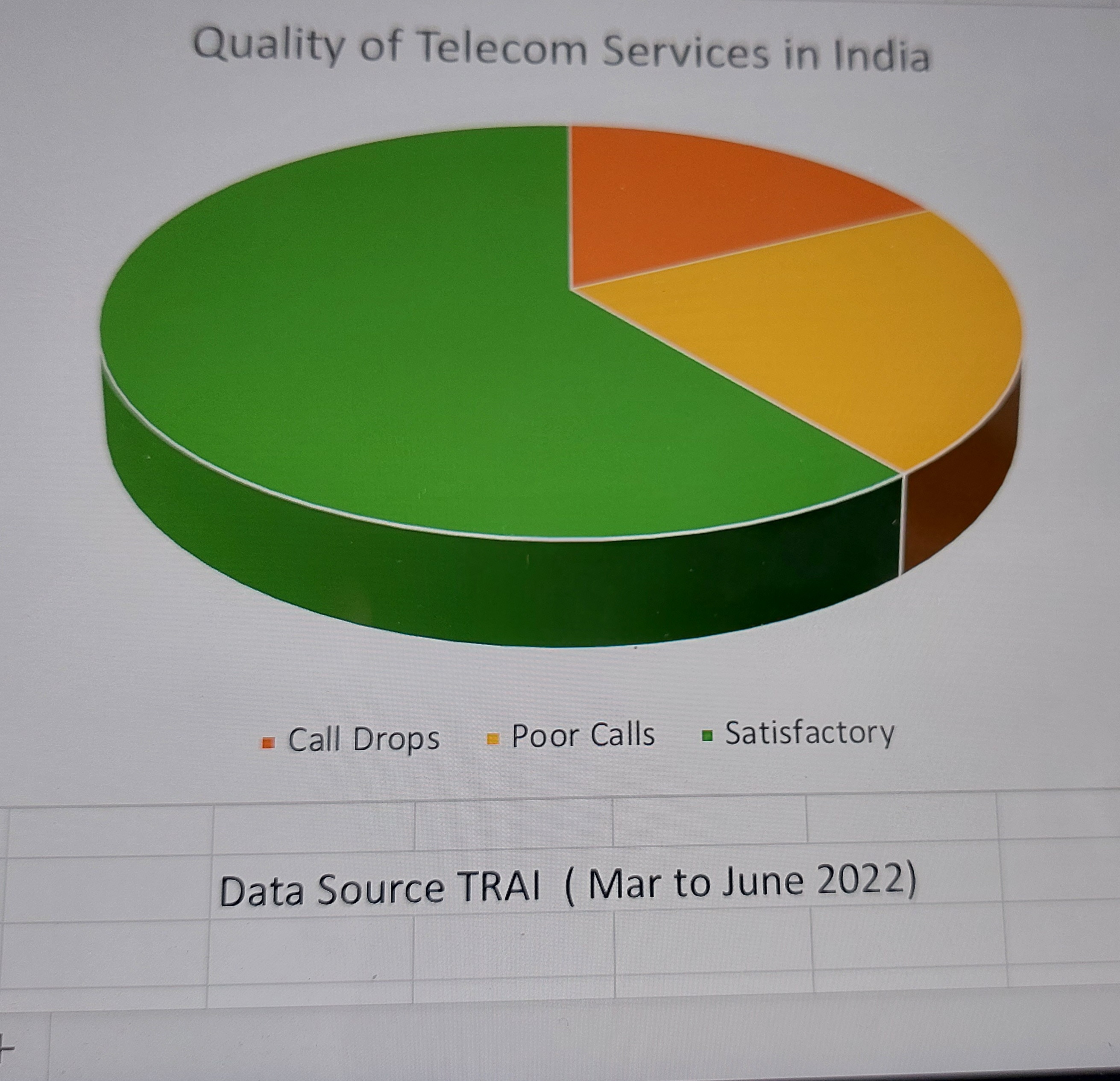
The Telecom Regulatory Authority of India (TRAI) has released the data for voice calls on its MyCall Dashboard portal .The results go a long way to reveal why most citizens in India use dual sims. Why despite paying twice to stay connected, Indians face some of the highest rates of call drop globally at 17.43% and are dogged by very poor voice quality. From the TRAI data we also learn  that apart from call drops 21.87% of the calls suffer from poor voice quality. Only 60% of the calls that we make are of satisfactory quality as per the TRAI website on 22nd June 2022. 

Strangely, Vodafone Idea with Best Voice Call Quality, Looses Money 

Call quality  for indoor calls received the poorest rating of 3.2 on a score of 5 while feedback from those calling from outdoor was slightly better at 3.4 on a score of 10. Comparison of voice quality across TSP showed VI score 4.0 , RJio scoring 3.2 , Airtel and BSNL getting 2.9 and 2.8 respectively. This development is however not recent. This has been a constant feature in competitive digital India since a decade.  As per the data reported by Financial Express on 6th January 2021 Vodafone Idea offered the best voice quality with very high ratings even during the December 2020 pandemic days.       


On a scale of 1 to 5 Idea registered 4.9 in the indoor / outdoor voice call quality with a a satisfactory  rating of 97.59% in terms of call quality experience. Vodafone also had a average voice quality rating of 4.3. and a consumer satisfaction rating of 87.68%. Yet the VodafoneIdea network has been struggling to retain consumers because it is saddled with debt and cannot afford to spend on marketing. Also it often does not enter locations where it does not have adequate infrastructure to provide good quality service. So in those areas it’s service is not great and you have to use the second network. Besides it has certain data speed issues and it looses out in the profitable area of data and video downloads.Having two networks is not an issue though the cost virtually doubles if it really ensures 100% connectivity on a 24x7 basis. But it does not, and friends and associates often complain that your network is always busy unless they have both your numbers and the time and energy to try out both.  We will in the next week find out why this problem is so persistent and what ails the networks and the efforts TRAI has made to improve services that has been resisted by the Telcos  . TRAI orders have been struck down by the Courts when they imposed penalties for call drop in 2017


Monday, June 13, 2022

Ed Tech startups reorganise, as funds dry up, separating the men from the boys


Physicswalla succeeds as Ed Tech Unicorns Struggle Despite Adequate Funding 

India has 14 lakh schools for 32 crore odd student population. Of this 60% students (190 million ) go to Government run schools and 40% students ( 130 million ) go to  private schools.  Schools were closed for 9 months of the year due to  lockdowns and economic uncertainties during the pandemic. This affected the basic economics of the  school infrastructure across the nation both for Government and private run schools as well as colleges. But it also created an opportunity for online education. Not only startups with liberal VC funding but even established universities like MIT and Harvard jumped in to expand online learning courses   But since India’s  aspirational student community was not ready to give up, the demand for online education grew stronger by the day. Two types of ed tech companies entered the fray. Some were those who were bootstrapping and were operating as non profits or low profits and growing organically till they achieved scale. Then there were others like Byju’s  who latched onto opportunities and secured VC funding from multiple global investors at an early stage to enter the lucrative top end of the market. 


Among the Ed tech companies catering to the bottom of the pyramid is Rocket Learning founded by Azeez Gupta that develops the basic foundational concepts for children upto the age of eight in math, science and languages. They currently work in two languages of Hindi and Marathi in four states of Maharashtra, UP, MP and Haryana with 8000 teachers and 100,000 children. Another successful grass root startup is Physicswalla which was founded by Allahabad based Alakh Pandey and Prateek Maheshwar in 2016 initially as a YouTube channel to assist engineering and medical students in the joint entrance exam. In 2020 it launched its app and website and turned profitable by the next two years with 500  teachers educating 6 million students. In 2022 Physicswalla became India’s 101 unicorn raising $100 million in its maiden funding round and becoming the seventh Ed tech unicorn after Byju’s, Unacademy, Eruditus, Vedantu, UpGrad and Lead School. Pandey plans to go vernacular in 9 Indian languages after this round of maiden fund raising. If he succeeds he will redesign the entire Ed Tech industry so heavily focused on English language students at the the top of the pyramid.


The Annual Status Education Report after the 1st wave of the pandemic done in October 2020 by education NGO Pratham revealed that about 43.5% of Government school children had no access to smartphones. While most students received textbooks, only a third of the students received learning materials through WhatsApp, phone calls, videos and online classes. A similar conclusion was reached by the Azim Premji Foundation which undertook a survey for disadvantaged children in five states of the country. Online education which is still in its early days was only helpful for about 30% (100 million) students across the country as per these surveys. 

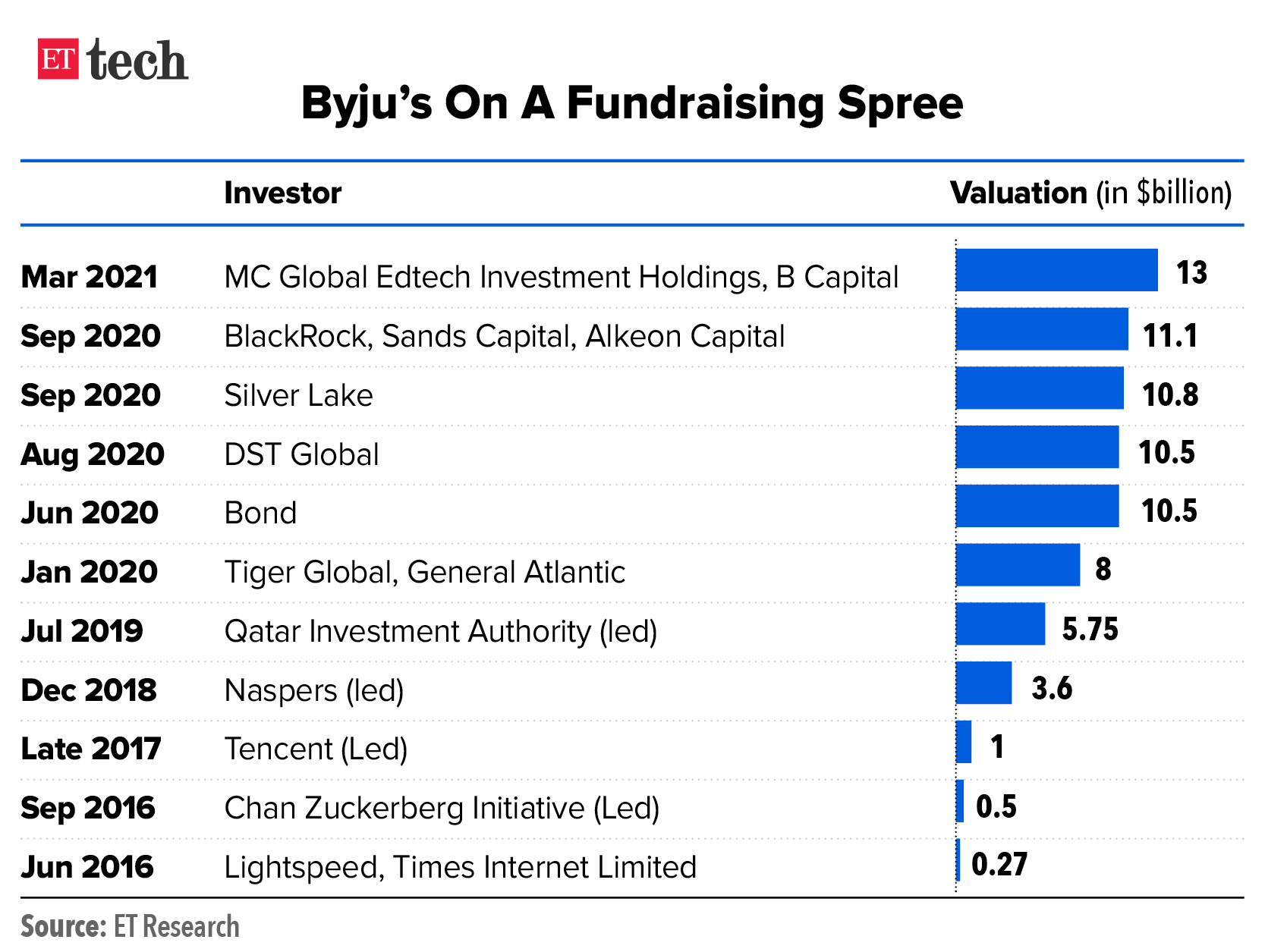
The funded Ed tech startups targeting these 100 million students at the top of the pyramid are reportedly in trouble with revenues falling short of expectations. In the past five years they have attracted an amazing $4billion of investors money. But their performance has been below par. Even the leader of the pack, the Bengaluru based Byju with a mammoth valuation of $40 billion and an annual paid subscriber base over 5 million students is under pressure. In the year 2021 Byju’s took the acquisition route and bought the coding tutorial services WhiteHat Jr for $300 million to gain traction. Soon after 800 teachers who were working from home resigned  after they were asked to report to office. So the expensive acquisition that was done by Byju’s, actually  lost the  expert pool of coders they had paid for. Thereafter they acquired the JEE tutorial services Aakash  Educational with 200 centres across India and a student base of 250,000 for $950  million, which was another pretty expensive acquisition. It remains to be seen how Byju uses to asset to scale up its online learning platform business.

Lido Learning founded by the former VP of Byju, Sahil Sheth in 2019 and funded by Alibaba,   Ronnie Screwvala of UpGrad  and Vijay Shankar of PayTM sacked 1200 employees in February 2022, whose salaries have still not been paid. In April and May Unacademy and  Vedantu sacked 600 employees each, as both unicorns began restructuring after indifferent results. VC funding of the Ed-tech industry has not yielded the desired results in India. There are reports of poor customer satisfaction and toxic work culture. Now that funding is drying up, many startups will fold up and few    survive and remodel their business. The consolidations and restructuring has already started and will soon separate the men from the boys. 


Thursday, May 5, 2022

Xiaomi Caught in Royalty Fraud and Money Laundering. $725 Million Assets Seized. Stocks Slump

Last Minute Seizure of $725 million at Bank. MD Manu Jain flees, relocates  to Dubai. 

The Enforcement Department ED moved to  seize assets of Rs  $725 million (Rs 5551 crore) of Chinese smartphone maker Xiaomi in India on the evening of Friday 29th April 2022. The ED action was based on information gathered by the IT Dept on massive tax evasion by Chinese phone makers. Just before Christmas last year the Income Tax Department had conducted nation wide searches on Xiaomi, Oppo and  OnePlus offices and its contract manufacturers and dealers that covered 25 cities including Delhi, Mumbai, Chennai, Bengaluru, Kolkata and Guwahati and seized data allegedly corroborating charges of tax evasion and money laundering during the searches.


Following the IT raid the ED had interrogated its Global VP Manu Kumar Jain, till recently the Managing Director of Xiaomi, at its Bengaluru office in April 2022 but had not served out a lookout notice for him as it was in the process of collecting evidence. Manu Kumar Jain an IIT Delhi and IIM Kolkata alumnus has reportedly  moved to Dubai following the IT raid and is no longer available in India. With no successor named as MD Xiaomi India remains headless reportedly to avoid scrutiny.  

The Financial Times reported that the Xiaomi share listed at the Hong Kong Stock Exchange tanked by as much as 6 per cent to HK$11.46 (US$1.46) before recovering. India is the biggest market of Xiaomi outside mainland China where it has sold 8 million handsets during the first four months of 2022 that helped it stay profitable as China sales slumped because Shanghai and many parts of China went under total lockdown. Investors apprehend  that  if  the enquiry drags on for six to eight months as is normally the case for such massive money laundering investigations, the revenues and profits of the company could dry up for the current year.  This because over the last 7 years Xiaomi has grown phenomenally in India with 22% market share outdoing the 30 year old popular market leader Samsung Electronics and is dependent on the Indian market for its healthy bottom line. 

A week after ED’s seizure of its assets in India the Xiaomi share was quoted at HK$11.10 close to its 52 week low of HK$10.64. This despite the fact that it received a stay from a single judge bench of Karnataka HC till further hearing of the ED seizure case on the 12th of May. Other companies dependent on imports from Xiaomi and MI were also affected. Dixon Tech is Xiaomi’s manufacturing partner for LED TVs. It’s share quoted at the BSE tanked by 14% to Rs 3784.75 on Wednesday Intraday trade to close near it’s all time low. Dixon is a company engaged in making several consumer durables, lighting, home appliances, mobile phones, smart TVs  and other electronic items in India and is partly dependent on Xiaomi,  MI,  Goldex (HK) Technology, and Syntech (HK) Technology for its supplies from China. However Dixon has also other supply lines  from South Korea and Taiwan and is expected to recover from the sharp loss.

Xiaomi India which began its India operations in 2014 started remitting large amount of royalties from the year 2015 that were designed to siphon out expenses before taxes though the company did not have any such agreements or have the permission of the Government to remit such royalties. The three companies to which it remitted foreign exchange included one company sub-owned by Xiaomi.  “Such huge amounts in the name of royalties were remitted on the instructions of their Chinese parent group entities,” said the ED in a statement. In case Xiaomi is found guilty of violating FEMA’s Section 4, they may be slapped with a penalty that can be at least three times the contravened amount. 
For  more on this story watch this space later this week.